- Indonesia’s Leading English News Website, Direct Daily from the Island of Bali.


GWK Road Dispute Heats Up
GWK Road Dispute Heats Up
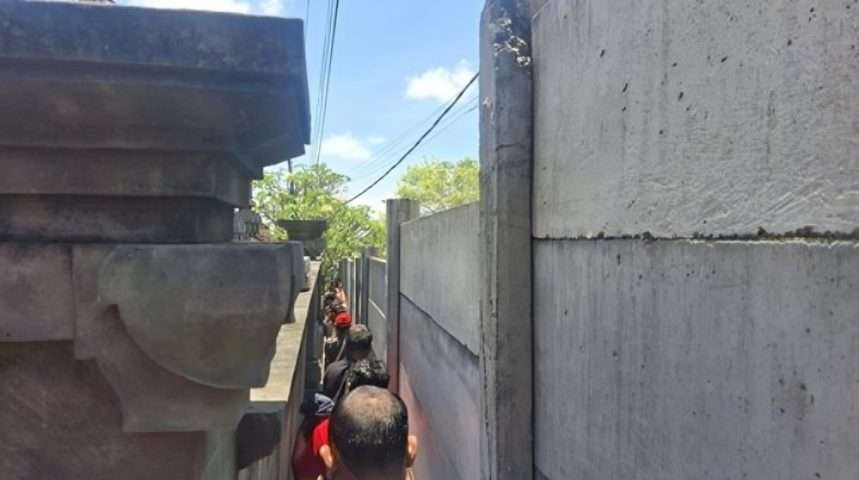
The wall built at GWK Cultural Park that blocks access for residents of Ungasan Village, South Kuta District, Badung.
BADUNG, Bali – The GWK road dispute at the Garuda Wisnu Kencana (GWK) Cultural Park in Ungasan, Badung, has drawn widespread attention after local residents complained about a concrete wall blocking the route they have long used as their main access in and out of their neighborhood.
Around 600 residents of Banjar Giri Dharma, a local community near the GWK complex, are reported to be affected. “We have lived here for decades. This road is our only access in and out of our homes. Now it has been closed just like that, and we feel like we are trapped on our own land,” one resident told Indonesia Exposé.
A joint commission of the Badung Regional Legislative Council (DPRD Badung), which conducted an inspection, confirmed the residents’ concerns. “The findings are extraordinary. There are many things that do not align with ethics or logic on the ground—how residents’ gates, the only way in and out of their homes, are blocked. These findings are inhumane,” said I Gusti Lanang Umbara, Deputy Chair of Commission I of the council, as quoted by detikcom.
GWK management, through its subsidiary PT Garuda Adhimatra Indonesia (GAIN), stated that the fencing was carried out on company-owned land. “The fencing was done on land owned by PT Garuda Adhimatra Indonesia (GAIN), and therefore GWK has the capacity to construct the wall,” management said in a statement quoted by detikcom.
Management added that the move had been preceded by community notification. “The fencing carried out by GWK was preceded by notifications of the plan to local residents, through official letters dated April 30, 2024, and July 10, 2024,” said a GWK representative.
Even so, regional authorities urged that the resolution should not rely solely on a formal approach. Bali Governor Wayan Koster emphasized the importance of cultural wisdom in finding a solution. “In terms of territoriality, because the road is within GWK’s land, formally GWK has the right to regulate it. But don’t rely only on a formal approach; it must also be addressed culturally and socially. GWK should regard the surrounding community as partners, not as adversaries,” he said.
Meanwhile, Bali’s Regional Office Head of the National Land Agency (BPN), I Made Daging, said the agency is still reviewing the land status. “There are indications that it is indeed a public road, but this needs to be confirmed. We cannot immediately make a decision solely based on initial reports without strong data,” he said, as quoted by Teras Bali News. On the other hand, BPN Badung, through its official representative, stated that the road has been recorded as an asset of the Badung Regency Government since 2002 and was even asphalted by the local government in 2007. This indicates a discrepancy in data that still needs further verification.
At the legislative level, the Bali DPRD pressed for immediate reopening of the access. “No one is allowed to close public access. In Balinese culture, there must not be any situation where residents are left without an entry and exit route,” said Bali DPRD member I Wayan Bawa, quoted by Bali News. He stressed that the council’s recommendation for the wall to be dismantled should be implemented without delay.
So far, mediation between residents, the government, and GWK management is still ongoing. GWK management stated it is ready to support a joint solution. “GWK remains committed to contributing and supporting the government, particularly in finding a solution to provide road access for the community,” said the official statement from management.