- Indonesia’s Leading English News Website, Direct Daily from the Island of Bali.


Gili Trawangan Water Crisis Forces Tourists to Leave Early
Gili Trawangan Water Crisis Forces Tourists to Leave Early
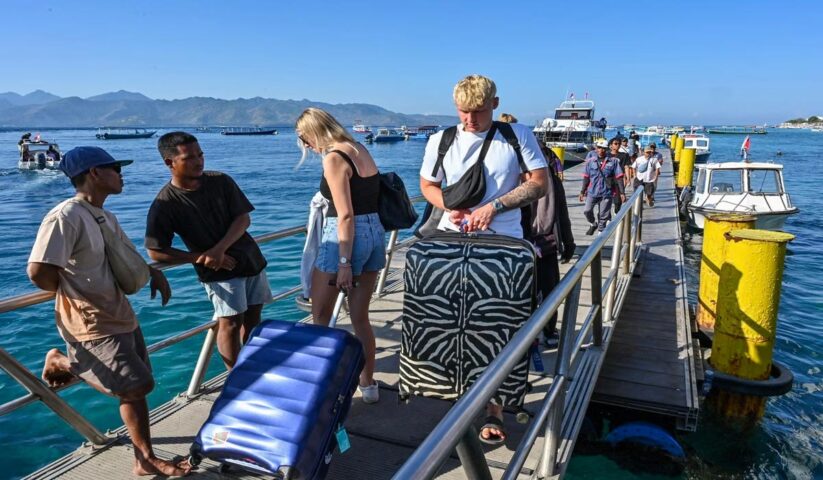
Illustration — Tourists with luggage at Gili Trawangan Port, North Lombok. (Photo: ANT)
GILI TRAWANGAN, Lombok — A clean water crisis on Gili Trawangan has forced hundreds of tourists to cut their stays short, while hotels and tourism businesses scramble to keep operating amid a disruption that has now prompted intervention from the West Nusa Tenggara government.
Around 300 tourists have reportedly checked out early after the island’s clean water supply stopped completely at around midnight on Thursday, September 3.
Lalu Kusnawan, chairman of the Indonesian Hotel General Manager Association (IHGMA) in West Nusa Tenggara and head of the Gili Trawangan Hotel Association, confirmed the figure on Saturday.
“About 300 people have chosen to check out early and leave Gili Trawangan,” Kusnawan said.
The water shortage has directly affected hotels and other accommodation businesses. Some operators have even had to drain swimming pools to obtain water for basic sanitation, while others have tried bringing supplies over by boat from mainland Lombok.
The alternative supply, however, comes at a significant cost and is still not enough to cover the island’s overall needs.
The timing has made the situation particularly difficult. Gili Trawangan is currently experiencing high visitor numbers, with more than 3,000 tourists visiting the Gili area each day, according to Kusnawan.
“We don’t know how long this situation will last. But if it continues for a week, we don’t know what will happen, because this is not the first time it has happened,” he said.
Tourism operators say they have raised the issue with the North Lombok regency and West Nusa Tenggara provincial governments. They are also preparing to send a letter to President Prabowo Subianto seeking a solution to the recurring water supply problem.
Government Moves to Restore Supply
The crisis has now prompted the West Nusa Tenggara Government to seek a short-term solution while addressing the regulatory and legal issues behind the disruption.
Governor Lalu Muhamad Iqbal said the provincial government was coordinating with the central government and other stakeholders to get the existing water network operating again.
“Two days ago I spoke directly with the Minister of Environment to explain this emergency situation. The water supply must continue because it concerns people’s lives, public services and the sustainability of the tourism sector,” Iqbal said on Sunday while visiting Gili Meno.
Iqbal acknowledged that the issue is complicated because it involves environmental considerations as well as legal and regulatory matters. However, he said those issues should not prevent residents and tourism businesses from receiving essential water supplies.
The provincial government has requested discretion to allow the existing water network to operate temporarily while the underlying regulatory and legal matters are resolved.
Iqbal said Environment Minister Mohammad Jumhur Hidayat had committed to helping find a solution, with the provincial government preparing to formalise the next steps through coordination and official correspondence between the relevant institutions.
“We will immediately look for a solution. We will communicate with the private sector and resolve the relevant regulatory issues to ensure the water can flow again as soon as possible,” Iqbal said.
The provincial government is targeting the water network to resume operations within one to two days, while the North Lombok government has begun supplying water to meet the immediate needs of residents and tourists.
Iqbal also apologised to residents, tourism operators and visitors affected by the disruption.
“We apologise to the community, tourism operators and the tourists who have been affected. The government is committed to resolving this issue as soon as possible,” he said.
For the short term, Iqbal said restoring the existing network was the most practical option. But he stressed that it should only be a temporary measure while a more permanent solution is developed.
The wider challenge is to find a way to secure reliable water supplies for the Gili islands without compromising environmental rules or legal requirements.
“For NTB, ensuring that the water flows again is not only about maintaining tourism activity, but above all about ensuring that people’s basic needs are met,” Iqbal said.
For Gili Trawangan, the latest disruption is a reminder that even one of Indonesia’s most popular island destinations remains vulnerable when essential infrastructure fails.
The immediate question is whether the water will be restored within the government’s one-to-two-day target — and whether a lasting solution can prevent the same problem from affecting residents, businesses and visitors again.