- Indonesia’s Leading English News Website, Direct Daily from the Island of Bali.


Bali Farmers Face Land Offers Worth Up to 20 Years of Harvests
Bali Farmers Face Land Offers Worth Up to 20 Years of Harvests
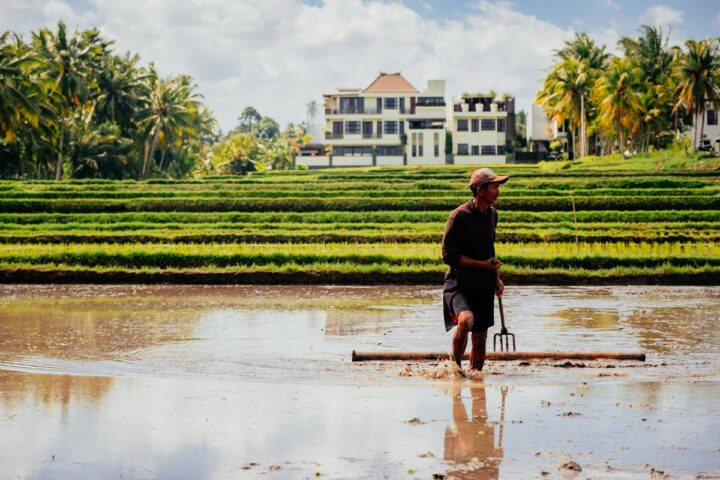
A farmer works in a rice field in Bali, where rising land values and development are adding to the economic challenges of preserving agricultural land. (Photo: unsplash.com)
DENPASAR, Bali — Bali farmers are being offered prices for agricultural land equivalent to as much as 20 years of harvest income, highlighting the economic challenge facing efforts to preserve the island’s rice fields amid rising land values and development.
Bali Governor Wayan Koster said landowners can receive offers equivalent to 10 to 20 years of agricultural earnings, creating a significant financial consideration for families whose land has been farmed for generations.
Speaking at a seminar on agricultural land protection in East Denpasar on September 20, Koster acknowledged that such offers can make selling an understandable economic decision for landowners.
The issue illustrates a broader challenge for Bali: regulations restricting the conversion of agricultural land may have limited impact if the financial returns from farming remain significantly below the potential value of selling the land.
“A ban on land-use conversion alone is not enough,” Koster said, arguing that agricultural protection should be accompanied by incentives that make retaining productive land economically viable.
Thousands of Hectares Already Lost
Bali lost around 4,000 hectares of rice fields between 2019 and 2025, according to figures previously cited by Agrarian Affairs and Spatial Planning Minister Nusron Wahid.
Bali authorities have also estimated that the conversion of productive agricultural land has been occurring at a rate of roughly 600 to 700 hectares annually, raising concerns about food production and the future of the island’s traditional subak irrigation system.
In July, Bali’s provincial and district governments agreed to designate 56,098.76 hectares, representing 87.01 percent of the island’s 2024 rice-field area, as Sustainable Food Agricultural Land, or LP2B.
The designation meets the national minimum target of 87 percent and is intended to provide stronger protection for productive agricultural land.
But land protection is only one part of the challenge.
Bali’s Farmers Are Getting Older
Bali is also confronting an ageing agricultural workforce.
Koster said much of the island’s agricultural workforce is now over the age of 50, while attracting younger generations to farming remains a challenge.
The combination of high land values and an ageing farming population means efforts to preserve Bali’s agricultural landscape increasingly involve both land-use policy and the economic sustainability of farming itself.
The provincial government has strengthened restrictions through Bali Provincial Regulation No. 4 of 2026, which addresses the conversion of productive agricultural land and nominee arrangements involving land ownership.
Koster has also called on notaries and Land Deed Officials, known as PPATs, to help ensure land transactions comply with applicable regulations and to prevent nominee arrangements.
“We must not sacrifice Bali for the sake of money,” Koster said.
The Economic Challenge of Preserving Farmland
For farming families, agricultural land can serve two different economic functions: it provides income through cultivation while also representing an increasingly valuable asset.
As Bali continues to attract investment and development, the difference between agricultural earnings and land values can make decisions over whether to retain or sell farmland increasingly complex.
That means preserving Bali’s rice fields may ultimately require more than restrictions on land conversion. It may also depend on whether farming can generate sufficient economic value for landowners to continue keeping their fields productive.
The challenge is therefore not simply how much agricultural land Bali can protect on paper, but how to ensure farming remains a viable livelihood for the families expected to preserve it.