- Indonesia’s Leading English News Website, Direct Daily from the Island of Bali.


235 Aftershocks Recorded After M7.7 Earthquake Hits Flores
235 Aftershocks Recorded After M7.7 Earthquake Hits Flores
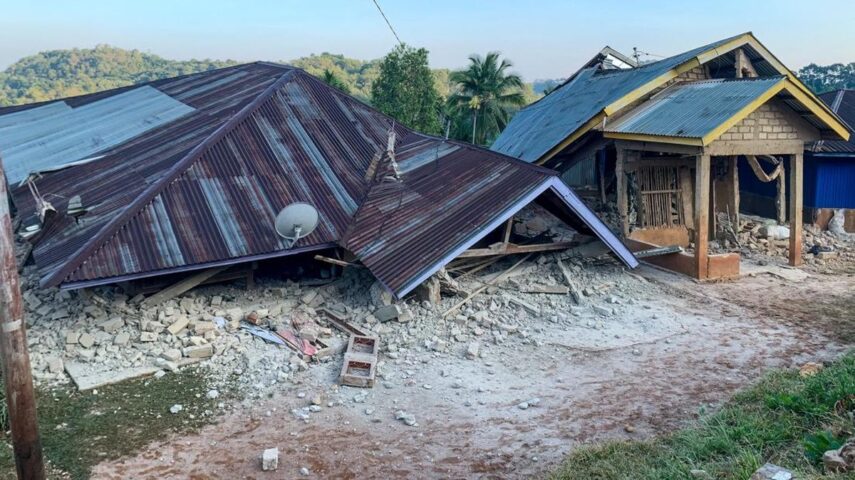
Several houses were severely damaged after a magnitude 7 earthquake struck Manggarai, East Nusa Tenggara, on Saturday (Aug. 15).
FLORES, East Nusa Tenggara — At least 38 people were killed after a powerful magnitude 7.7 earthquake struck off the coast of Flores in East Nusa Tenggara on Saturday, as rescue teams continued assessing damage and dealing with hundreds of aftershocks across the region.
The Meteorology, Climatology and Geophysics Agency (BMKG) recorded 235 aftershocks by 2 p.m. local time, ranging in magnitude from 2.5 to 6.2. BMKG said the aftershock activity had not yet shown a significant decline.
The main earthquake struck at 4:58 a.m. local time. BMKG placed the epicenter about 30 kilometers northeast of Mbay, Nagekeo Regency, at a depth of 15 kilometers.
A tsunami warning was issued shortly after the earthquake, prompting authorities to urge residents in affected coastal areas to move away from beaches and riverbanks.
The warning was lifted at 7:30 a.m. after BMKG monitoring showed that the tsunami threat had subsided. Residents were nevertheless urged to remain alert because aftershocks were continuing.
Rescue Operations Continue
The earthquake caused severe damage in several parts of Flores, with collapsed buildings and landslides reported in affected areas.
The National Disaster Management Agency (BNPB) said 38 people had died, with casualties reported mainly in Sikka, Manggarai and East Manggarai regencies.
At least 13 people were injured, including two who suffered serious injuries.
Sixteen of the victims were reportedly recovered from a landslide in Reok village, Manggarai Regency.
BNPB deployed three helicopters and a rescue vessel to support emergency operations, including the delivery of logistics and possible evacuations.
About 2,000 residents in Nagekeo Regency were reported to have fled their homes and moved to temporary shelters.
Landslides Disrupt Key Route
The earthquake also triggered landslides that disrupted sections of the Trans-Flores highway in Ende Regency.
The roughly 700-kilometer route is a major road connection across Flores, linking Labuan Bajo in the west with Larantuka in the east.
Power outages and communication disruptions in several areas have also complicated the flow of information and the emergency response.
Authorities continued collecting reports on casualties and damage as rescue teams reached affected communities.
Hospitals Move Patients Outdoors
Several hospitals evacuated patients from buildings as a precaution following the strong shaking.
Medical staff moved beds, intravenous equipment and oxygen cylinders outdoors and established temporary treatment areas.
In Sikka Regency, students at St. Peter Major Seminary, also known locally as Ritapiret Seminary, fled during morning Mass after part of an assembly hall collapsed.
The seminary’s rector, Rev. Guidelbertus Tanga, said at least one priest suffered a broken leg after jumping from the second floor of a building during the earthquake.
The earthquake was also felt in Labuan Bajo, a major gateway to Komodo National Park. Damage was reported in other areas of Flores and neighboring regions.
Authorities Urge Residents to Stay Alert
With hundreds of aftershocks still being recorded, authorities have urged residents in affected areas to remain cautious and follow information from BMKG and local emergency agencies.
The continuing seismic activity means the situation remains fluid, with casualty and damage figures potentially changing as search-and-rescue teams reach more affected locations.
The latest BMKG update underscores that the immediate emergency has not ended with the lifting of the tsunami warning, as authorities continue to respond to damage, disrupted access and ongoing aftershocks.